Showing posts with label kim in-kwon. Show all posts

Friday, March 13, 2015

Tazza: The Hidden Card: War Is a Card Game

No one's saying that you need when to know when to play the crane and when to play the butterflies in the card game Go-Stop in order to be able to follow the action in Kang Hyeong-cheol's Tazza: The Hidden Card. For someone like me (i.e., a completely ignoramus), each time a card was thrown down -- be it the cuckoo or the sake cup -- I had to wait for the collective onscreen reactions before I knew who'd won and who'd lost. Here's what I could follow.

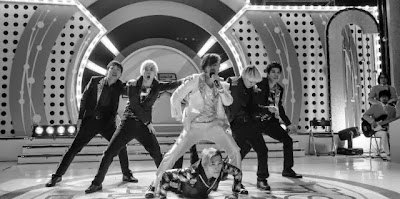
Teen hustler De-gil (Choi Seung-hyun) only has eyes for the sassy sister (Shin Se-kyung) of a neighborhood boy (Kim In-kwon) until he sees a dancing cartoon character on the clean white panties of a femme fatale (Lee Ha-nui) who basically sells one of his kidneys for a big score which leads him to a life on the run where he encounters a small-time crook (Yoo Hae-jin) who's got big life lessons to share that come in handy when he's forced to face off with two master criminals (Kim Yun-seok and Kwak Do-won).

For clarity's sake I've edited out all the backstabbing betrayals and shaky partnerships that precede the final Go-Stop game conducted in underwear (which came as a let-down after a promise of nudity in the subtitled dialogue). By that point, you won't give a damn about how the actual card game works because you'll be too invested in the various players and how they're playing each other.

You might not know it from the title and you'd certainly never guess it from watching the movie but Tazza: The Hidden Card is actually a sequel, the follow-up to Choi Dong-hoon's immensely box office smash Tazza: The High Rollers. Though the two movies feature return performances by a couple of actors — but sadly not Kim Hye-su who was such a wonderful dragon lady in the original — the majority of the cast as well as the director (Kang Hyeong-choi) and his writing collaborators (Cho Sang-bum and Lee Ji-gang) are entirely new. If there were any major narrative callbacks to the original, I certainly didn't catch them. Nor did I miss them. Nor did I want them.

Friday, December 13, 2013

The Tower: The Architecture of Laughter and Disaster

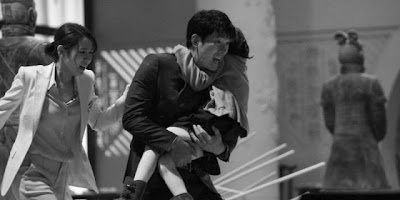
In reality, The Tower isn't about a single skyscraper going up in flames. It's about two skyscapers: one damaged when a too-close helicopter -- crassly sprinkling artificial snow -- collides into it; the other threatened by the domino effect should the first towering inferno fall. For obvious reasons, the title can't play up the conflagration of two twin towers. Not on this side of the Pacific anyway, where the World Trade Center attack of 2001 remains a national tragedy. Plus, the parallels are pretty problematic when you consider how hilarious The Tower often is. Sometimes the humor is intentional: two lovebirds spitting out fire extinguisher foam, a lowly maid complaining of a rich lady's dog poop. Most times, the jokes are unintentional: the pregnant lady (Min Jeong) prying open an elevator; a self-centered hotel exec spiraling down to his death. Those last two items might not sound funny but when you see them, believe me, you'll realize they are.

And what else is there to do but laugh at the collective struggle in writer-director Kim Ji-hoon's deliriously nutty disaster pic? You know from the beginning that the Head of Facilities (Kim Sang-kyung), his waterworks-of-tears daughter (Jo Min-ah), and the lady in the white pantsuit (Son Ye-jin) are going to end up a happy family at the end. You also know that the martyr of a squad captain (Sol Kyung-gu) is going to sacrifice his life to save others, although when and how that happens is constantly delayed. Maybe you're not sure whether the lowly maid and her college-going son will be reunited. All said, tension is not The Tower's strong point. What the movie has in its favor is some beautiful cinematography of computer generated flames, explosions, smoke clouds, and even the towers themselves which sparkle like giant pieces of jewelry. I also would like to say I got a kick out of Kim In-kwon who plays the cocky little firefighter who I personally hope gets promoted and forces his compatriots to get matching mohawks once the self-sacrificing captain bites the CGI dust.

Saturday, October 12, 2013

Born to Sing: Live to Cry

Do I cry too easily? Possibly. Because even a very predictable, conventional movie about a talent show and its hard-luck singing contestants can turn me into a bucket of tears. I don't know why I'm so easily manipulated even when, like with Born to Sing, I can see where it's going right from the very beginning. The forgetful old man (Oh Hyeong-kyeong) with the prickly granddaughter (Kim Hwan-hee) is going to get the love he deserves; the bashful 20-something (Lee Cho-hee) swoony for her adorable co-worker (Yoo Yeon-seok) is going to get kissed, married and laid in that order; and the henpecked has-been (Kim In-kwon) is going to get back to his rock roots and win over a nation and his hairdressing wife (Ryu Hyeon-kyeong). I cried for every story, every success, every cliche. Pretty much every time!

Before the tears, I confess my interest in Born to Sing was fleeting. As directed by Lee Jong-pil, this sitcom of uplift isn't as competent in building back stories or belly laughs. The comic relief -- an off-key mayor (Kim Su-mi), an overaged delivery boy (Kim Jung-gi) and a self-advancing politico (Oh Kwang-rok) -- are each a little too real. What could've been a series of comically quirky characters come across as sad, small-town lives. Not that sad, mind you. I didn't cry for them. They're more depressing in a lightweight, inoffensive kind of way. Like people you meet in life, people who have their own small dreams and self-delusions, people that aren't going to win and who you'll never see again so really what does it matter.

Is there a subversive message here? Are we expected to chase our dreams and not settle for less after watching Born to Sing? Should we crash the karaoke bars and open mics and company off-site talent shows? To be honest, I hardly think so. I think we'd be better off heading to the cineplex to see good movies like this one and, if we're lucky, something better.

Saturday, February 25, 2012

Quick: An Action-Comedy That Will Make Your Head Explode

Let's pretend for a moment that you're a movie director and a highly amusing action-comedy script comes across your desk. From the looks of it, if you can get the required budget and the right actors, the action sequences promise to be breathtaking and the best comedic bits will be gut-bustingly funny. The problem is that the parts in between them are, frankly, kind of boring and border on the incomprehensible. What do you do? Do you bring in another writer, a crackerjack script doctor perhaps, to tighten up the exposition and iron out the wrinkles or do you go back to the original screenwriters and say, "Give me more action, more slapstick, and less talk." I'm guessing Cho Beom-gu took the latter approach -- many times in fact -- because while Quick still has a few, fairly short, dull explanatory sections that tell us why this rash of bombings is happening throughout Seoul, it's a hell of a lot less concerned with explaining why the leather-clad pop diva Ah-rom (Kang Ye-won) has a time-bomb motorcycle-helmet strapped to her head and more committed to having her scream nonsensically and gesticulate wildly as former-boyfriend/expert-motorcyclist/indie-courier Gi-soo (Lee Min-ki) races from one location to the next. Who cares why these two ex-lovers are being forced to execute a series of death-defying assignments when you get to see so many spectacular car pile-ups and so many glamorously fiery explosions? Not me.

You'll see Gi-soo's motorcycle leap from buildings, smash through glass, crash through steel, outrace trains, cop cars and overweight detectives running nonsensically after him on foot. The implausible part is a major contributing factor to why Quick is so deliriously good. The ridiculousness elevates the movie, even as it extends outside the action. How crazy does it get? How about when a weary, naked Ah-rom showers with her helmet on or when Gi-soo's self-deluded romantic rival Myeong-sik (Kim In-kwon) backbends under a sixteen-wheeler careening and aflame right above him? While that particular moment is clearly the result of some fancy green screen CGI special effects, Quick is by no means without its own dose of reality. Stick around for the closing credits which reveal behind-the-scenes footage of the bruises, the bang-ups, and the broken bones suffered by both the cast and their body doubles who skid motorcycles under trucks or propel their bodies recklessly through space for the perfect shot. The risks taken may seem crazy when you consider that they're all just for a silly action pic but personally, I think their efforts were worth it.

Friday, September 9, 2011

The Anarchists: The Nicest Terrorists You'll Ever Meet

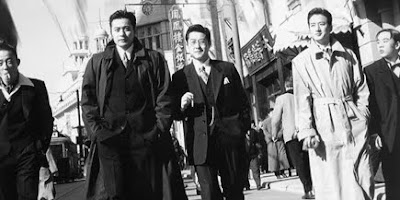
On the eve of the tenth anniversary of 9/11, it's more than a little weird to watch Yu Yong-sik's The Anarchists (a.k.a. Anakiseuteu Anarchists) because this historical bromance about Korean terrorists who assassinate Japanese oppressors in 1920s Shanghai is so little about politics and violence and so much about brotherhood and youthful aimlessness. With a screenplay by none less than Park Chan-wook, The Anarchists isn't shy about slaughter. Men are stabbed, shot repeatedly, slit in the throat... Even women get tortured. But most of the time, this movie's all about male bonding, how young revolutionary Sang-gul (Kim In-kwon), once rescued from the gallows, comes to love and respect his mentors in the revolution. They're a likable bunch: a nihilistic opium addict named Seregay (Jang Dong-gun), a hotheaded prankster named Dol-suk (Lee Beom-su), a bespectacled didact named Myung-Gon (Kim Sang-jung) and a wannabe radical named Geun (Jeong Jun-ho) who never really seems to have his heart in the cause even as he's willing to sacrifice his life to it. Though the characters never break into a chorus of "Friendship / Friendship / Just a perfect blendship," you do get the feeling that they're humming it when the camera pans away.

Platonic loyalty is hardly unique to Park's canon. Think of the absurdly devoted women in Lady Vengeance or the extreme devotion among the soldiers in J.S.A.: Joint Security Area. But the camaraderie shared by characters written by Park but directed by others always feels more palsy-walsy than sealed in blood. In both Yu's The Anarchists and Lee Mu-yeong's The Humanist, the extremism that defines unconditional love is tempered, leaving something more like chumminess in its place. Admittedly, few directors can match Park's ability to glamorize violence without losing its grotesqueness. De Palma and Scorsese immediately come to mind. And Yu, admittedly has one scene that comes close: A slow-mo bit in which Seregay gets a bullet hole in the head then falls backwards, his descent captured at various camera angles heightening the surreality of the cigarette still smoking between his now-dead lips. But that's an isolated moment. Most bloody encounters in The Anarchists are a little too tamely respectful of the audience to actually achieve something that would earn the audience's wildly undying respect.